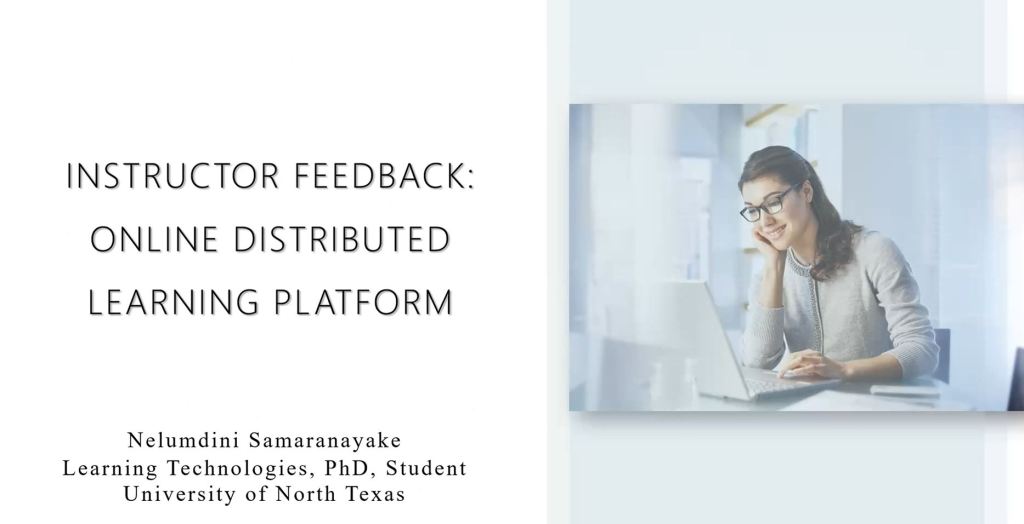
Feedback is essential to enhance students’ performance in an online learning platform; this setting will influence how feedback is delivered. The presentation contained a sample of 42 students in an online distributed learning environment. Students were requested to rate their experience with the feedback received from the instructor. This study was intended to discover the learner’s preference for the delivery of instructor feedback and how this impacted the learner.
Samaranayake, N. (2022) Instructor Feedback: Online Distributed Learning Platform
Around 260 million children do not have primary or secondary education. Everyone has the right to education according to the universal declaration of Human Rights article 26. Education prepares people to solve problems in their lives. For sustainable development, the curricula must promote communication, collaboration, critical thinking, innovation, and creativity as a continuous process. Exploring new ways of providing access to content change, copyright laws, creating localized digital libraries, sunshine to charge the battery, and ways of providing education on a global scale in a rapidly changing educational environment is a necessity.
Baker, R. Samaranayake, N. (2021), Sustainable education to all. Presentation proposal accepted for International Society for Performance Improvement (ISPI) EMEA 2021 Annual Conference.
Accepted Presentation – Ethics in Digital Environment
Technology is advancing rapidly with an increase in interpersonal interactions. With the digital technology advancement, ethical issues in the digital environment have led to prominent discussions in education.
The demand for online learning has risen since the COVID-19 pandemic. The twenty-first-century learner expectations have changed with online learning and the possibility to access education anytime/anywhere beyond a classroom setting. Massive Open Online Courses (MOOCs) are open education resources (OER). Through Coursera and EdX, MOOCs offer education to a diverse learning population globally through online platforms making education more accessible and sustainable. MOOCs create opportunities to improve skill training openness and enhance careers.
Samaranayake, N. (2022) Sustainable Education to All: Connecting learning through MOOCs (Class Presentation)
The experiential theory addresses the need and wants of the learner. Assessing success is through self-evaluation. Rogers emphasizes the importance of learning to learn and an openness to change. Experiential learning allows students to apply and gain knowledge in real-life scenarios. The experiential theory addresses the need and wants of the learner.
Samaranayake, N. (2021) Experiential Learning Theory Carl Rogers (Class presentation)
3D printing technology development came into light around 1980 and offers significant potential to healthcare; 3D printing can produce customized products that change society and lives. In contrast, business models are transforming working environments and adding value to sustainability. The new development has enabled and transformed healthcare advances in orthopedics, radiology, pediatrics, and oncology and how surgeries are performed.
Samaranayake, N. (2022) Emerging Technology 3D Printing in Healthcare (Class presentation)
As technology advances, devices can replicate and imitate our real-world environment. Extended reality makes the human lifestyle more present in the virtual world and guarantees an immersive experience: virtual, augmented, and mixed realities give more opportunities to broaden human understanding. This research presentation attempts to promote extended reality in the scope of refugee education, community building, and supplying XR educational experience to developing counties.
Samaranayake, N. (2023) SITE, New Orleans presentation
The demand for online learning has risen since the COVID-19 pandemic. The twenty-first-century learner expectations have changed with online learning and the possibility to access education anytime/anywhere beyond a classroom setting. Massive Open Online Courses (MOOCs) are open education resources (OER). Through Coursera and EdX, MOOCs offer education to a diverse learning population globally through online platforms making education more accessible and sustainable. MOOCs create opportunities to improve skill training openness and enhance careers. A qualitative framework study attempts to determine whether 21st-century online learning skills of 4C’s communication, collaboration, critical thinking, and creativity which build skills to succeed in the 21st- century economy, are fostered in the MOOCs learning platform.
Samaranayake, N. (2022) EduLearn22 Presentation
A considerable improvement has taken place in online learning in recent years. With the sudden outbreak of COVID-19, the deadly disease hitting the entire world, the education system shifted from classroom teaching to remote instructions overnight to accommodate the students through online remote instructions. Synchronous teaching challenged the instructor to incorporate the classroom curriculum into an online learning setting; teachers changed their teaching methodologies, struggled to manage time, and developed content that engaged the student and merely covered the curriculum. At the same time, students had to adapt to the synchronized learning environment. With the current development of online learning, ethical issues in education have become a meaningful conversation. This paper examines how instructors and students adapt ethical behavior in the online learning environment.
Samaranayake, N (2021) AECT presentation
Instructional designers have a history of being designers of learning activities. With the growing requirements of structuring, designing, and creating course materials, a subset of designers has risen as a designer by assignment, also called novice designers, with limited instructional system design and design theory training. The presentation incorporated the soft system methodology analysis stage and system thinking to find a broader overview of the instructional design proficiencies required by designers by assignment in the instructional design field to create learning materials effectively and efficiently.
Samaranayake, N. (2022) Analysis of an instructional design system (Class presentation)
As technology advances, devices can replicate and imitate our real-world environment. Extended reality makes the human lifestyle more present in the virtual world and guarantees an immersive experience: virtual, augmented, and mixed realities give more opportunities to broaden human understanding. This research presentation attempts to promote extended reality in the scope of refugee education, community building, and supplying XR educational experience to developing counties.
Samaranayake, N. (2022) Analysis of an instructional design system (Class presentation)
 Nelumdini Samaranayake, Ph.D.